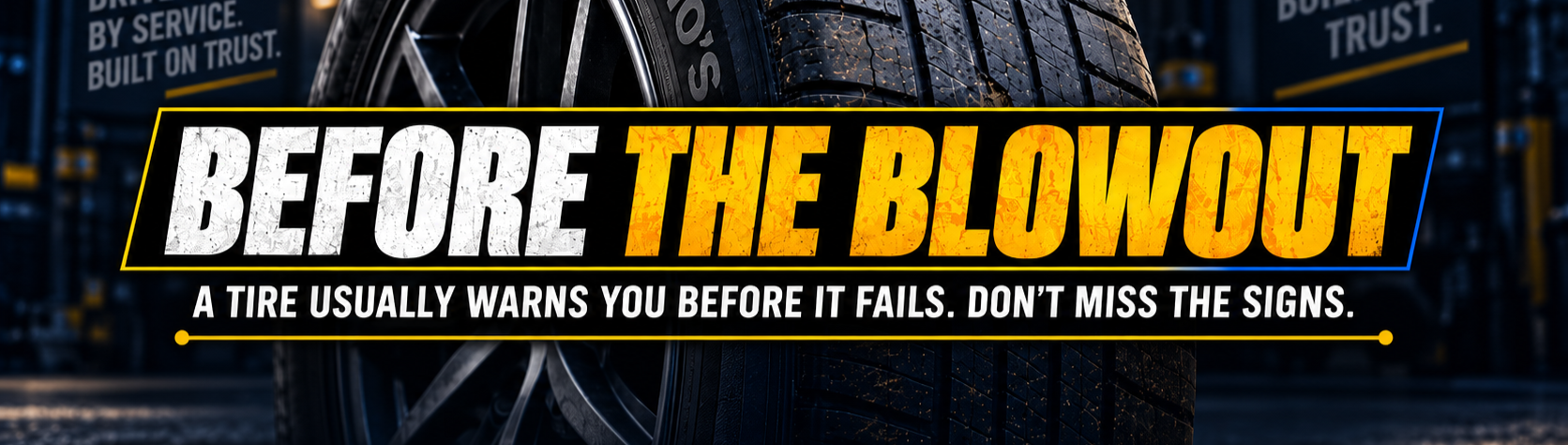
A tire blowout can feel like it happened without warning.
Usually, it didn’t.
Tires often show subtle signs of damage, wear, or pressure problems long before they fail. Knowing what to look for can help you catch a problem early—before it leaves you stranded or creates a dangerous situation on the road.
Here are six warning signs worth checking.
Your Before-the-Blowout Checklist
☐ 1. Cracks in the Sidewall
Take a close look at the side of your tires.
Small cracks, splitting, or a dry, weathered appearance can indicate that the rubber is beginning to deteriorate. Age, heat, sunlight, and environmental exposure can all contribute to sidewall cracking.
Minor surface cracking doesn't always mean immediate failure, but deep or widespread cracking deserves professional inspection.
Look for: Cracks, dry-looking rubber, splits, or exposed material.
☐ 2. A Bulge or Bubble
A bubble or bulge in the sidewall is one warning sign you should take seriously.
It can indicate damage to the internal structure of the tire, sometimes caused by hitting a pothole, curb, or other road hazard.
Once the tire's internal structure is compromised, the affected area may no longer be able to safely contain pressure.
Look for: Any unusual bump, knot, bubble, or outward bulge in the sidewall.
See one? Don't ignore it. Have the tire inspected immediately.
☐ 3. Uneven Tread Wear
Your tread should wear relatively evenly across the tire.
When one section wears much faster than another, your vehicle may be telling you something.
Uneven wear can be associated with:
Alignment problems
Improper tire pressure
Suspension issues
Lack of regular tire rotation
Wheel or balance problems
Catching unusual wear early may help protect both your tires and other vehicle components.
Look for: Inside-edge wear, outside-edge wear, bald patches, cupping, or noticeably different tread depths across the tire.
☐ 4. Low Tread Depth
Tread is what helps your tires maintain contact with the road—especially when conditions are wet.
As tread wears down, the tire becomes less capable of channeling water away from the contact patch, which can reduce traction and increase the risk of hydroplaning.
Most tires also have built-in tread wear indicator bars. When the tread becomes level with those bars, the tire has reached the end of its usable tread life.
Look for: Shallow grooves, visible wear bars, or sections of tread that appear nearly smooth.
☐ 5. Your Tire Keeps Losing Air
Adding air every few months because temperatures changed is one thing.
Adding air to the same tire over and over again is another.
Recurring pressure loss may indicate a nail or screw, leaking valve stem, wheel issue, bead leak, or other damage.
And driving on an underinflated tire can create additional heat and stress inside the tire.
Look for: One tire consistently dropping pressure faster than the others or a tire-pressure warning that repeatedly returns.
☐ 6. Vibration or Shaking While Driving
A steering wheel vibration isn't always just “the road.”
Persistent shaking or vibration can sometimes be caused by tire or wheel problems, including:
Tire imbalance
Uneven tread wear
Internal tire damage
Bent wheels
Alignment or suspension issues
If your vehicle suddenly begins vibrating differently than usual—especially at highway speeds—it's worth having it checked.
Look for: New or worsening vibration in the steering wheel, seat, or vehicle at certain speeds.
Quick Tire Safety Check
Before your next road trip—or simply while your vehicle is sitting in the driveway—take a minute to check all four tires.
Ask yourself:
☐ Are there cracks in the sidewalls?
☐ Do I see any bubbles or bulges?
☐ Is the tread wearing evenly?
☐ Is there enough tread remaining?
☐ Does one tire constantly lose air?
☐ Have I noticed new vibration while driving?
If you answered yes to even one, don't wait for the problem to get worse.
Catch It Before It Becomes a Blowout
A tire problem is usually easier to deal with in the shop than on the side of the highway.
If something doesn't look or feel right, bring your vehicle to Despino's Tire Service. Our team can inspect your tires, identify unusual wear or damage, check pressure and tread condition, and help determine whether the tire can be serviced safely or needs to be replaced.